

|

|
|
Who Gets Arrested When Two Family Members Are Fighting?
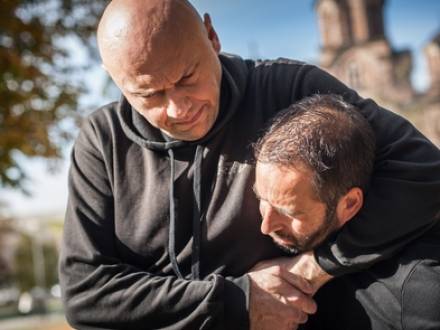 When we hear the term "domestic violence," we usually think of violence between two people in a romantic relationship. That said, there are many times when domestic violence involves family members rather than romantic partners.
But when two relatively physically matched family members are involved in an argument that turns physical, who gets arrested? The answer to this question is not an easy one, and the police do not always get it right. If you have been arrested for domestic violence, but you were only defending yourself, it is important to speak to an experienced Rolling Meadows, IL domestic violence defense lawyer to understand your options.
Who Could Be Arrested for Domestic Violence Under Illinois Law?
Illinois criminal law says that domestic violence can apply to any two people who have any type of domestic relationship. This could include parents and children, grandparents and adult children, siblings, or even cousins, not to mention those you are related to by marriage – your in-laws.
Most families experience conflict at one time or another. In some instances, such conflict can turn physical. Both battery and domestic violence are generally charged as Class A misdemeanors in Illinois, which carry up to a year in jail. However, domestic battery can be prosecuted as a Class 4 felony if the defendant has a prior criminal background of domestic violence or violating protective orders (720 ILCS 5/12-3.2). A Class 4 felony is punishable by one to three years in prison.
Who Gets Arrested When the Police Show Up?
When the police receive a complaint of domestic violence and both people have injuries, it is the officer’s job to evaluate each person individually to try to determine which party was the primary aggressor. The officer may look at which party has the majority of the injuries and how severe those injuries are.
If there have been prior complaints of domestic violence for one or both parties, this is likely to be a major factor in which party is arrested. In many cases, it can come down to which party’s story is more believable, along with disparities in size between the two parties. This is not an exact science with clear rules. Deciding who to arrest during a family conflict can be very subjective. The police officer at the scene has the final say.
What this means from a practical standpoint is that a larger sibling is more likely to be arrested than a smaller sibling, even if the smaller person was the primary aggressor. Someone who was only defending himself or herself could still face charges of domestic violence.
What Happens After a Domestic Violence Arrest in 2026?
After a domestic violence arrest in Illinois, the court quickly decides whether the accused can be released before trial. In many cases, pretrial release is allowed with conditions. Those conditions may include no contact with the alleged victim.
Release is not guaranteed. If prosecutors argue that the accused poses a clear danger to another person, the court may deny pretrial release. This often comes up in sibling domestic violence cases where threats, prior incidents, or serious injuries are alleged, or when both parties live in the same home. The judge reviews police reports and arguments from both sides. Protecting safety is the court’s main concern at this stage.
Defenses to Charges of Domestic Violence
Self-Defense
The right person does not always get arrested in domestic violence cases. The police typically arrive once the violence has been stopped and must try to guess who the primary aggressor was. If you reasonably believed that your family member was about to assault you, you may have a self-defense claim. It may be relevant if the family member you are accused of assaulting has a history of behaving violently towards you.
Self-defense can also come up in sibling domestic violence cases. A person may claim they used force only to stop an attack or protect themselves from being hurt. However, the amount of force used should match the perceived threat. Courts often look at what happened right before the fight, who started it, and whether the person could safely walk away. Photos and doctor’s notes can show whether the force was proportionate or not.
Mutual Combat
In Illinois, mutual combat may be a mitigating circumstance in battery cases. This might be even more common among siblings who grew up with one another and have willingly fought before.
Sometimes, one person may claim they were the victim when they were actually the aggressor. If that happens, the defense attorney may need to challenge that claim. One way is to show a pattern of past false allegations, if there is proof. Other evidence can also help, like texts, videos, witnesses, or medical records.

Plea Bargain to Misdemeanor Assault
Family violence between siblings is still considered domestic violence under the law. However, it is not always treated the same as violence between romantic partners. In some cases, the court may be more open to reducing the charge to misdemeanor assault. This depends on the facts, the injuries, and any prior history between the family members. Domestic violence cases are rarely dropped, even when the victim requests it.
False Allegations by the Other Party
Domestic violence allegations should always be taken seriously, but not every accusation is true or made in good faith. One person may exaggerate or make a claim to gain leverage, seek revenge, or influence court decisions. These cases can be deeply harmful, since an accusation alone can damage a person’s reputation, family relationships, and future.
False accusations can sometimes be uncovered when the accuser’s statements don’t line up with the timeline of events. Exposing a clear ulterior motive can also cast doubt on an accusation.
Contact an Arlington Heights, IL Domestic Violence Defense Attorney
If you are facing charges of domestic violence, you must take these charges seriously. Our experienced Rolling Meadows, IL defense lawyer at Scott F. Anderson, Attorney at Law has more than 25 years of experience in criminal law, both as a prosecutor and now as a criminal defense attorney. To schedule your free consultation, call 847-253-3400 today.
CALL US TODAY AT 847-253-3400 FOR A FREE INITIAL CONSULTATION
Client accused of burglary was acquitted due to our skillful cross examination of eye witness identification.
Client accused of causing the death of another while driving under the influence - Acquitted.
Client accused of first degree murder - Acquitted.
Client accused of embezzlement - Charges never filed.
Hundreds of Secretary of State hearings for Drivers License Reinstatement - Won.



121 S. Wilke, Suite 301, Arlington Heights, IL 60005
847-253-3400
